Improving operational efficiency through order planning
Designed order workflows to reduce operational errors, improve visibility, and simplify shipment creation for Industries.

Overview
Operational teams needed a faster and more reliable way to process incoming orders, validate inventory, and plan deliveries at scale.
I designed an end-to-end order planning platform that enabled teams to review incoming orders, validate stock availability, consolidate deliveries, and create trips from a single workflow. The solution reduced manual effort, improved operational visibility, and streamlined planning activities across fulfillment teams.
Problems
As order volumes grew, operational teams faced increasing challenges in managing fulfillment efficiently.
No clear visibility into order readiness and inventory availability
Difficulty consolidating multiple orders into a single shipment
High dependency on operational experience and manual decision-making
Inefficient Truck Utilization
High Dependency on Human Coordination
These issues increased operational delays, pricing inconsistencies, and workflow inefficiencies.
Goals
Design a centralized order planning experience that enables teams to:
Track incoming orders from a single place
Instantly identify inventory availability
Reduce spreadsheet dependency
Simplify shipment planning workflows
Reduce cognitive load, guide users in complex decisions
Improve transportation utilization
Final Designs
Research & Discovery
To understand the operational ecosystem, I studied real-world workflows used by teams managing inventory movement and order processing.
Research Activities
Conducted Secondary Research on existing operational flows
Spoke with users involved in daily order and shipment processing
Identified how information moved across teams and systems
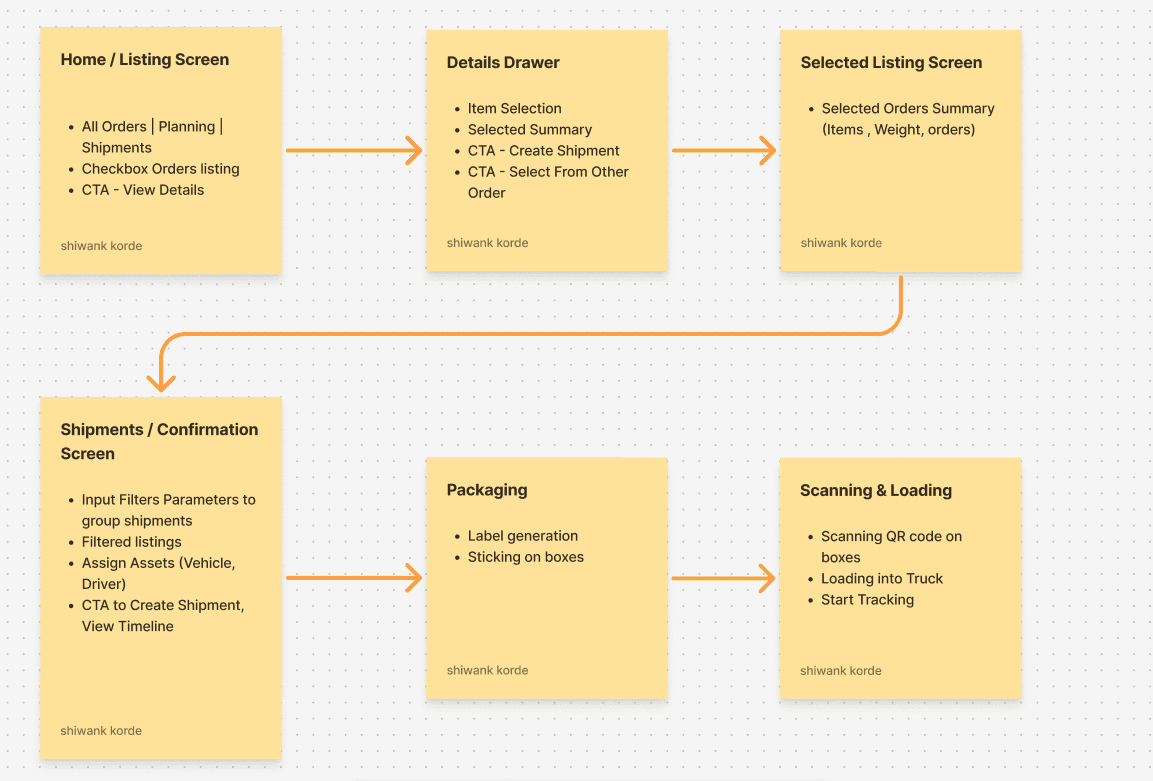
Organized workflows into clearer operational stages


Workflow
Impact
Reduced dependency on spreadsheets and manual coordination
Improved visibility across incoming orders and inventory readiness
Created a scalable workflow capable of handling growing order volumes
Reduced operational effort required for shipment planning
Improved transportation planning efficiency
Improved operational efficiency through order planning
Designed order workflows to reduce operational errors, improve visibility, and simplify shipment creation for Industries.
Overview
Operational teams needed a faster and more reliable way to process incoming orders, validate inventory, and plan deliveries at scale.
I designed an end-to-end order planning platform that enabled teams to review incoming orders, validate stock availability, consolidate deliveries, and create trips from a single workflow. The solution reduced manual effort, improved operational visibility, and streamlined planning activities across fulfillment teams.
Problems
As order volumes grew, operational teams faced increasing challenges in managing fulfillment efficiently.
No clear visibility into order readiness and inventory availability
Difficulty consolidating multiple orders into a single shipment
High dependency on operational experience and manual decision-making
Inefficient Truck Utilization
High Dependency on Human Coordination
These issues increased operational delays, pricing inconsistencies, and workflow inefficiencies.
Goals
Design a centralized order planning experience that enables teams to:
Track incoming orders from a single place
Instantly identify inventory availability
Reduce spreadsheet dependency
Simplify shipment planning workflows
Reduce cognitive load, guide users in complex decisions
Improve transportation utilization
Final Designs
Research & Discovery
To understand the operational ecosystem, I studied real-world workflows used by teams managing inventory movement and order processing.
Research Activities
Conducted Secondary Research on existing operational flows
Spoke with users involved in daily order and shipment processing
Identified how information moved across teams and systems
Organized workflows into clearer operational stages
Workflow
Impact
Reduced dependency on spreadsheets and manual coordination
Improved visibility across incoming orders and inventory readiness
Created a scalable workflow capable of handling growing order volumes
Reduced operational effort required for shipment planning
Improved transportation planning efficiency
Improving operational efficiency through order planning
Designed order workflows to reduce operational errors, improve visibility, and simplify shipment creation for Industries.
Overview
Operational teams needed a faster and more reliable way to process incoming orders, validate inventory, and plan deliveries at scale.
I designed an end-to-end order planning platform that enabled teams to review incoming orders, validate stock availability, consolidate deliveries, and create trips from a single workflow. The solution reduced manual effort, improved operational visibility, and streamlined planning activities across fulfillment teams.
Problems
As order volumes grew, operational teams faced increasing challenges in managing fulfillment efficiently.
No clear visibility into order readiness and inventory availability
Difficulty consolidating multiple orders into a single shipment
High dependency on operational experience and manual decision-making
Inefficient Truck Utilization
High Dependency on Human Coordination
These issues increased operational delays, pricing inconsistencies, and workflow inefficiencies.
Goals
Design a centralized order planning experience that enables teams to:
Track incoming orders from a single place
Instantly identify inventory availability
Reduce spreadsheet dependency
Simplify shipment planning workflows
Reduce cognitive load, guide users in complex decisions
Improve transportation utilization
Final Designs
Research & Discovery
To understand the operational ecosystem, I studied real-world workflows used by teams managing inventory movement and order processing.
Research Activities
Conducted Secondary Research on existing operational flows
Spoke with users involved in daily order and shipment processing
Identified how information moved across teams and systems
Organized workflows into clearer operational stages
Workflow
Impact
Reduced dependency on spreadsheets and manual coordination
Improved visibility across incoming orders and inventory readiness
Created a scalable workflow capable of handling growing order volumes
Reduced operational effort required for shipment planning
Improved transportation planning efficiency
Improved operational efficiency through order planning
Designed order workflows to reduce operational errors, improve visibility, and simplify shipment creation for Industries.
Overview
Operational teams needed a faster and more reliable way to process incoming orders, validate inventory, and plan deliveries at scale.
I designed an end-to-end order planning platform that enabled teams to review incoming orders, validate stock availability, consolidate deliveries, and create trips from a single workflow. The solution reduced manual effort, improved operational visibility, and streamlined planning activities across fulfillment teams.
Problems
As order volumes grew, operational teams faced increasing challenges in managing fulfillment efficiently.
No clear visibility into order readiness and inventory availability
Difficulty consolidating multiple orders into a single shipment
High dependency on operational experience and manual decision-making
Inefficient Truck Utilization
High Dependency on Human Coordination
These issues increased operational delays, pricing inconsistencies, and workflow inefficiencies.
Goals
Design a centralized order planning experience that enables teams to:
Track incoming orders from a single place
Instantly identify inventory availability
Reduce spreadsheet dependency
Simplify shipment planning workflows
Reduce cognitive load, guide users in complex decisions
Improve transportation utilization
Final Designs
Research & Discovery
To understand the operational ecosystem, I studied real-world workflows used by teams managing inventory movement and order processing.
Research Activities
Conducted Secondary Research on existing operational flows
Spoke with users involved in daily order and shipment processing
Identified how information moved across teams and systems
Organized workflows into clearer operational stages
Workflow
Impact
Reduced dependency on spreadsheets and manual coordination
Improved visibility across incoming orders and inventory readiness
Created a scalable workflow capable of handling growing order volumes
Reduced operational effort required for shipment planning
Improved transportation planning efficiency
Improving operational efficiency through order planning
Designed order workflows to reduce operational errors, improve visibility, and simplify shipment creation for Industries.
Overview
Operational teams needed a faster and more reliable way to process incoming orders, validate inventory, and plan deliveries at scale.
I designed an end-to-end order planning platform that enabled teams to review incoming orders, validate stock availability, consolidate deliveries, and create trips from a single workflow. The solution reduced manual effort, improved operational visibility, and streamlined planning activities across fulfillment teams.
Problems
As order volumes grew, operational teams faced increasing challenges in managing fulfillment efficiently.
No clear visibility into order readiness and inventory availability
Difficulty consolidating multiple orders into a single shipment
High dependency on operational experience and manual decision-making
Inefficient Truck Utilization
High Dependency on Human Coordination
These issues increased operational delays, pricing inconsistencies, and workflow inefficiencies.
Goals
Design a centralized order planning experience that enables teams to:
Track incoming orders from a single place
Instantly identify inventory availability
Reduce spreadsheet dependency
Simplify shipment planning workflows
Reduce cognitive load, guide users in complex decisions
Improve transportation utilization
Final Designs
Research & Discovery
To understand the operational ecosystem, I studied real-world workflows used by teams managing inventory movement and order processing.
Research Activities
Conducted Secondary Research on existing operational flows
Spoke with users involved in daily order and shipment processing
Identified how information moved across teams and systems
Organized workflows into clearer operational stages
Workflow
Impact
Reduced dependency on spreadsheets and manual coordination
Improved visibility across incoming orders and inventory readiness
Created a scalable workflow capable of handling growing order volumes
Reduced operational effort required for shipment planning
Improved transportation planning efficiency
Improved operational efficiency through order planning
Designed order workflows to reduce operational errors, improve visibility, and simplify shipment creation for Industries.
Overview
Operational teams needed a faster and more reliable way to process incoming orders, validate inventory, and plan deliveries at scale.
I designed an end-to-end order planning platform that enabled teams to review incoming orders, validate stock availability, consolidate deliveries, and create trips from a single workflow. The solution reduced manual effort, improved operational visibility, and streamlined planning activities across fulfillment teams.
Problems
As order volumes grew, operational teams faced increasing challenges in managing fulfillment efficiently.
No clear visibility into order readiness and inventory availability
Difficulty consolidating multiple orders into a single shipment
High dependency on operational experience and manual decision-making
Inefficient Truck Utilization
High Dependency on Human Coordination
These issues increased operational delays, pricing inconsistencies, and workflow inefficiencies.
Goals
Design a centralized order planning experience that enables teams to:
Track incoming orders from a single place
Instantly identify inventory availability
Reduce spreadsheet dependency
Simplify shipment planning workflows
Reduce cognitive load, guide users in complex decisions
Improve transportation utilization
Final Designs
Research & Discovery
To understand the operational ecosystem, I studied real-world workflows used by teams managing inventory movement and order processing.
Research Activities
Conducted Secondary Research on existing operational flows
Spoke with users involved in daily order and shipment processing
Identified how information moved across teams and systems
Organized workflows into clearer operational stages
Workflow
Impact
Reduced dependency on spreadsheets and manual coordination
Improved visibility across incoming orders and inventory readiness
Created a scalable workflow capable of handling growing order volumes
Reduced operational effort required for shipment planning
Improved transportation planning efficiency